
A Brief History

August 3rd 2015 marked the 1250th anniversary of St Andrew’s church.
Precise dating comes from the grant of land by Osmund, king of the South Saxons, “for the building of a monastery” in Ferring. Translated from the original Latin, it concludes:
“This charter was written on the third day of the month of August 765 years from the incarnation of our Lord. I, Osmund, have signed the grant with my own hand. I, Osa, Bishop, have agreed and signed.”
A second charter followed in AD 791, a grant of woodland to “the church of Saint Andrew, which is situated in the land which is called Ferring” – proof that the church had already been built by this time.
St Andrew’s is one of the oldest churches in Sussex. It was built a century before the peace which followed Alfred the Great’s defeat of the Vikings, which encouraged the building of many churches in England.
Early Saxon churches were thatched, timber buildings, consisting of a rectangular nave with a narrow arch leading to a much smaller chancel. When the church floor was re-laid in 1968-69, three small holes were revealed in the brickearth on the north side of the nave, possibly the post-holes of an early timber wall.
By the early 12th century however, St Andrew’s had been entirely rebuilt in stone. The chancel, northern aisle and porch were added later, so that by the mid-13th century the church became the size it is today.
In 1790, The Topographer magazine publishes a two-part article entitled “History of Ferring in Sussex” which included the line; “The place appears to have been once considerably larger than at present from the foundations, and old walls that are often dug up, and still visible”.
There is a theory that a bell tower once stood above the porch, and this could explain the thickness of the porch walls (which are wider than the Early English north aisle wall supporting the roof). The doorway which can be seen inside the east wall of the porch may once have led up to a belfry, and so The Topographer writer could be referring to masonry that had fallen from an old bell tower.
At this time, St Andrew’s had three bells which were mounted in a wooden frame on the ground outside the church. In 1792, permission was given by the Bishop of Chichester to sell the two smaller ones to fund the building of a bell tower. The largest bell, cast in 1651 by Bryan Eldridge of Chertsey, was raised into the new tower and is still in use today.
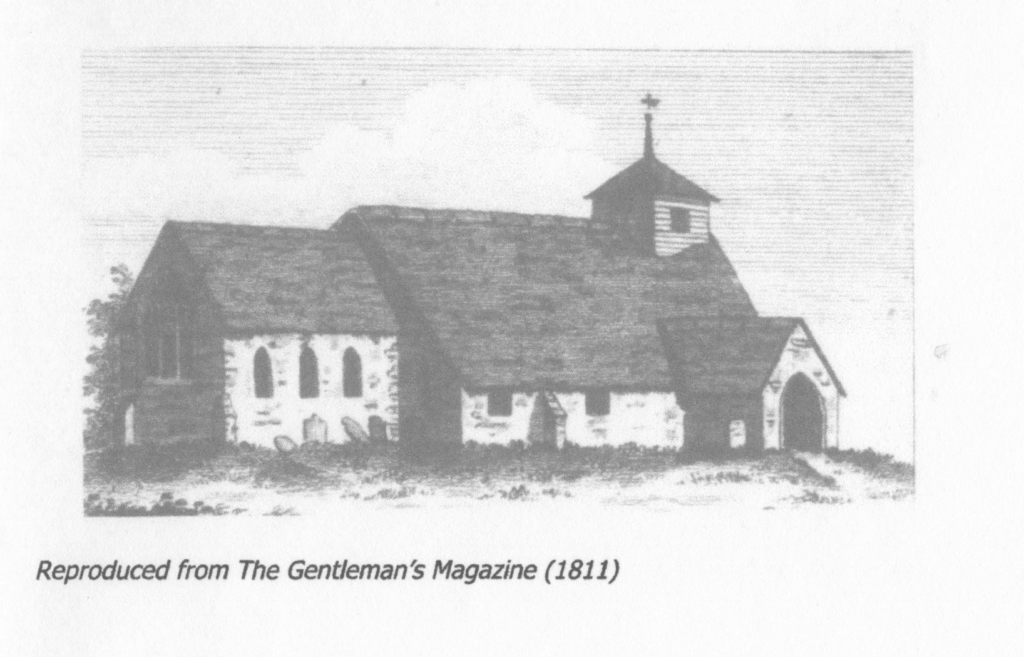
A report on St Andrew’s published in The Gentleman’s Magazine of 1811 said: “Ferring Church is a low building, consisting of a nave, North aile (sic), and chancel; it is built of flint. At the West end is a small wooden turret.” This “wooden turret” was the new bell tower, clearly shown in the illustration below.
St Andrew’s is a Grade I listed building, parts of which are almost a thousand years old, and throughout the centuries there have been countless repairs and restorations, improvements and alterations. By the late 19th century, the “small wooden turret” had been replaced by the tile-hung bellcote that can be seen today. This was a time of many changes to St Andrew’s, both interior and exterior, most which were funded by the Henty family of Ferring Grange.
The Hentys has their own private entrance to St Andrew’s, through the doorway which now leads from the vestry. Three Henty footmen operated the barrel organ which provided the church with music until a pipe organ was installed in 1871.
Originally located in the south-west corner, the organ was moved several times over the years until in 1964 it returned to the south-west, where it still stands. At the same time the rod and lever tracker action was replaced by an electric one and a new console with a double manual keyboard was installed.
Throughout its history, St Andrew’s has changed and adapted to meet the demands and needs of the era. The same is true today. In 2013, for example, a Quiet Corner was established in the north-west of the church, a place for private prayer and contemplation. In 2017, a new lighting system was installed, creating an improved environment for worshippers and visitors.
At a time when many churches face an uncertain future, St Andrew’s parish church of Ferring, can look forward to the coming centuries with confidence.
Researched and written by David Garnett